



How Far Can a 22 Calibre Air Rifle Shoot Accurately?
When you are setting up for a shot in the field, range is not an abstract debate — it is a decision with consequences. Choosing a 22 calibre air rifle for hunting or pest control means committing to a distance at which you can reliably and humanely dispatch quarry, every time. That ceiling is not fixed by the rifle's ballistic capability alone. It is shaped by your pellet, the conditions on the day, and — most critically — your own demonstrated accuracy from positions you will actually be shooting from. Getting this right is not just about performance. It is the foundation of ethical, responsible shooting.
What Do We Mean by Accurate Range - and Why It Matters for Hunting
Maximum range and effective accurate range are not the same thing. A .22 pellet can travel well beyond 100 metres in the right conditions. The question is whether it is still hitting with enough precision and retained energy to do what you need it to do at that distance.
For hunting and pest control, the standard shifts. You are not grouping shots on paper - you are placing a single pellet precisely enough to humanely dispatch an animal. That requires both accuracy and adequate energy on impact. If either falls below what the situation demands, the shot should not be taken.
The distinction that matters most
Maximum range tells you how far a pellet will travel. Effective accurate range tells you how far you can place that pellet on a kill zone with confidence, in real field conditions. For ethical pest control, only the second number counts.
This distinction is worth anchoring early because it shifts how you think about range limits. The ceiling is not the rifle's ballistic capability - it is where your groups start opening up and where you begin second-guessing the shot. That is where responsible hunters draw the line.
The Physics of a .22 Pellet in Flight: Velocity, Drop, and Energy Retention
The heavier .22 pellet carries a meaningful advantage over .177 when it comes to energy retention at close-to-medium ranges, and similar principles apply when considering .25 calibre air rifle pellets for UK hunting. More mass means the pellet decelerates more slowly through the air, delivering more of its kinetic energy into the target. For pest control - where the goal is clean, decisive impact on small quarry - that matters.
The trade-off is trajectory. A heavier projectile launched at lower velocity drops more steeply than a lighter, faster .177. At 30 metres the difference may be manageable with good scope zeroing. At 50 metres and beyond, that drop becomes significant - and variable wind makes it less predictable still.
- Muzzle velocity: Higher velocity flattens trajectory and extends the usable range window
- Pellet weight: Heavier pellets drop faster but retain energy better at moderate distances
- Pellet shape: Dome-head hunting pellets in .22 calibre offer a better balance of accuracy and ballistic consistency than pointed or flat designs for hunting
- Wind: Even a light crosswind will push a subsonic .22 pellet off course at longer distances
- Temperature: Cold air is denser, increasing drag and accelerating drop - particularly relevant in winter pest control sessions
Understanding these physics does not require a ballistics degree. It does require honest field testing so you can see where your specific setup - rifle, pellet, zero distance - starts to lose consistency.
How Power Level Affects Effective Range: Sub-12 ft/lb vs FAC .22 Air Rifles
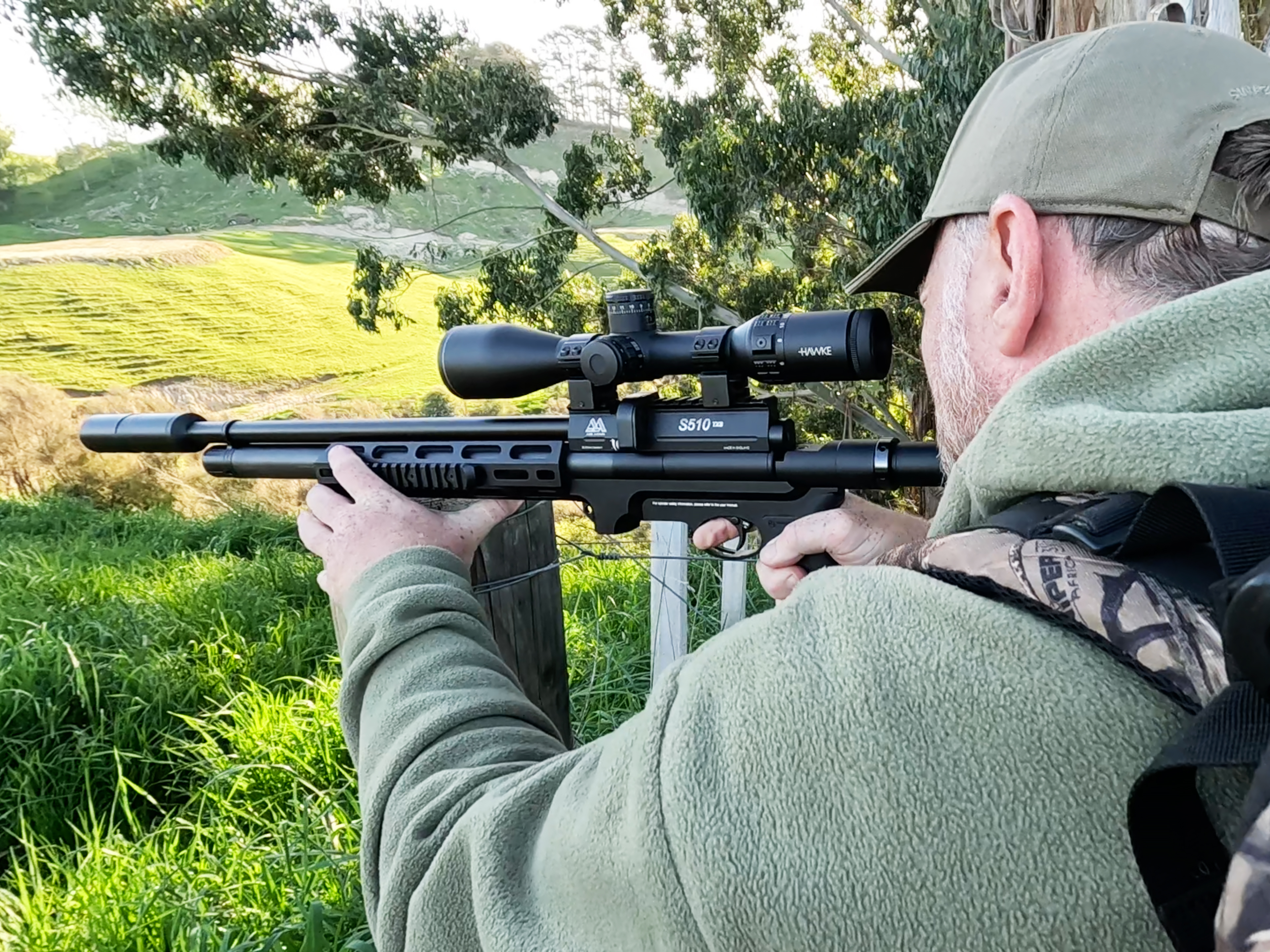
In the UK, air rifles are legal without a firearms certificate up to 12 ft/lb of muzzle energy. For a .22 calibre rifle operating at the legal limit, this is the practical ceiling for muzzle power - and it directly shapes what effective hunting range looks like. Not all powered air rifles behave the same at that limit, and the range picture can differ between PCP air rifles, spring rifles, and CO2-powered models. PCP air rifles use highly pressurized air cylinders, typically around 200-250 bar, which helps support stable output and higher performance.
At sub-12 ft/lb, the honest effective range for ethical pest control on quarry such as rats, rabbits, and grey squirrels is broadly in the region of 25 to 40 metres. Within that window, a well-zeroed .22 with the right pellet will deliver consistent accuracy and sufficient energy. Beyond it, energy retention drops, trajectories become harder to compensate, and the margin for error shrinks to a point where clean dispatch can no longer be guaranteed.
What a FAC rating changes
A Firearms Certificate (FAC) allows shooters to use air rifles producing more than 12 ft/lb. For a .22 air rifle, this translates into a substantially higher muzzle velocity, flatter trajectory, and extended effective range. Pest controllers working larger properties or open ground often find that an FAC-rated .22 opens up shooting situations that would be irresponsible with a standard-limit rifle. Users must hold the appropriate certificate and comply with all applicable legislation before operating an FAC-rated air rifle.
With an FAC .22 air rifle, effective accurate range can extend meaningfully - but only up to the point where the shooter can still deliver consistent groups on a kill-zone-sized target from field positions. PCP rifles are often virtually recoilless and high-powered, which can make that extra range more usable in practice. Spring air rifles use a coiled spring to propel pellets, while CO2 air rifles use cartridges to release gas for firing. Higher power does not eliminate the need for disciplined range assessment; it expands the window in which that discipline can operate.
Factors That Shrink or Extend Your Practical Shooting Distance
The same rifle can perform very differently depending on conditions, setup, and shooter preparation. Two factors above others tend to have an outsized effect on what is realistically achievable.
Scope setup and zeroing
A quality scope on a .22 air rifle is not optional for hunting at meaningful distance - it is foundational. Open sights limit your ability to resolve a precise aim point, especially on small targets at 30+ metres. A scoped setup lets you place the reticle with the kind of precision that consistent, ethical shots demand.
Zeroing matters just as much as the optic itself. Most hunters zero their .22 at 25 to 30 metres, then use holdover or turret adjustments for longer distances. The right zero point depends on your most common shooting distance - it is worth spending bench time understanding your specific drop profile before relying on it in the field.
Shooting position and support
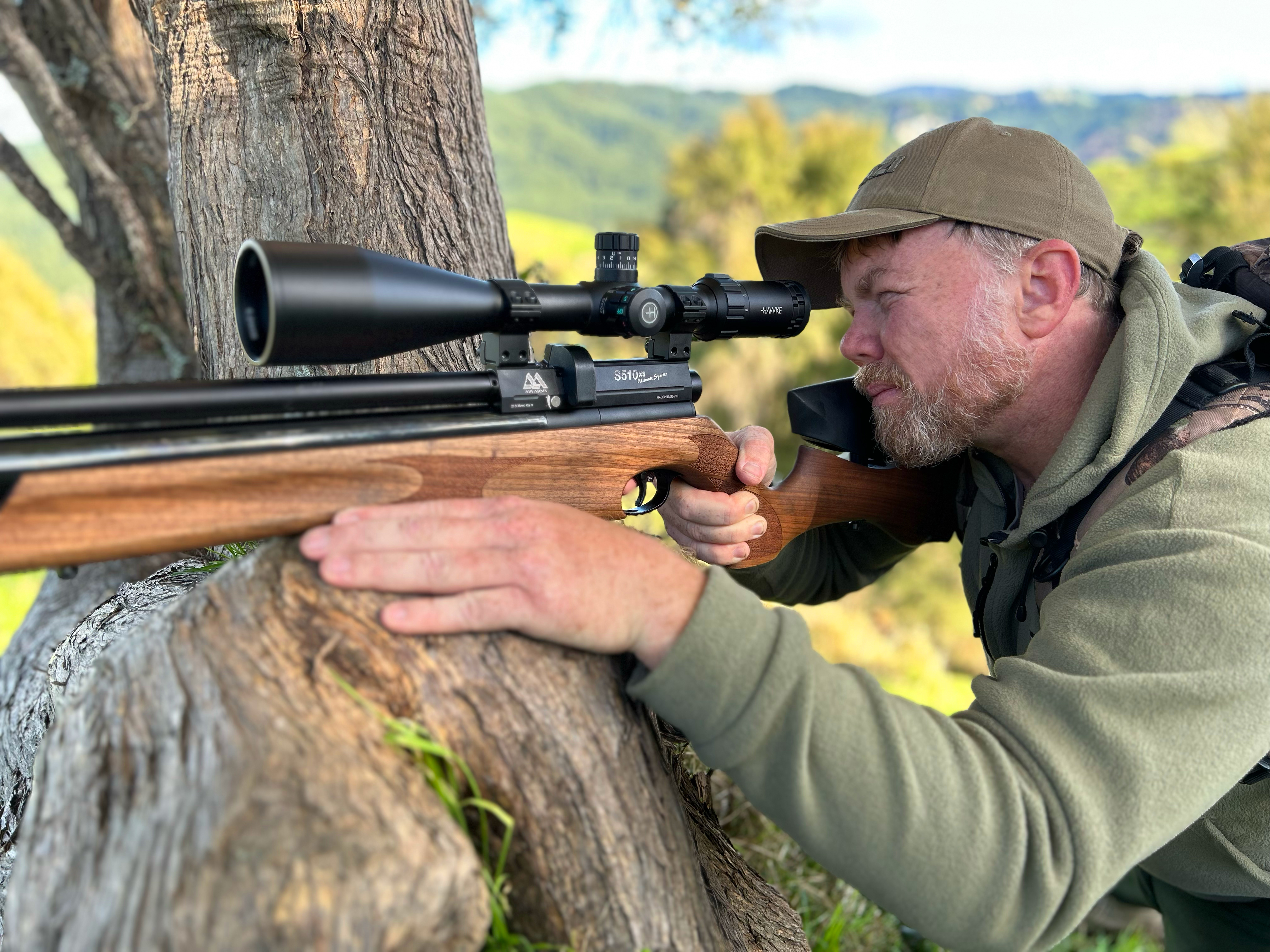
Range achieved from a supported prone position will often be substantially greater than from a standing or sitting position with no rest. In field pest control, you rarely get to choose - which means your practical effective range needs to account for the positions you will actually be shooting from, not the best-case scenario from the bench.
- Wind: A consistent crosswind of even 5 mph will move a subsonic .22 pellet noticeably at 40+ metres
- Shooting angle: Steeply angled shots upward or downward affect pellet trajectory and point of impact
- Light conditions: Low light reduces your ability to read mirage, assess wind, and confirm target identification
- Pellet consistency: Inconsistent pellet quality introduces spread that compounds at distance
- Rifle condition and maintenance: Basic air rifle maintenance after each session helps keep accuracy consistent. A clean, well-maintained barrel produces tighter groups than one that has been neglected, but barrel cleaning on a .22 air rifle should usually be infrequent so you do not strip away useful lead lubrication unnecessarily. When cleaning is needed, pull-through kits are generally preferred for air rifle barrels. Excess oil can cause dieseling, which may damage seals and affect velocity. A spring piston rifle should not be dry-fired because it can cause internal damage.
Platform matters
A rifle that delivers regulated, consistent shot-to-shot power will hold its accuracy better at range than one with variable muzzle energy. Air Arms rifles like the S510 Tactical - built on a regulated PCP platform - are designed to deliver repeatable performance across a full magazine, which is exactly what pest control situations demand when follow-up shots matter. By contrast, spring and PCP air rifles each have distinct advantages and spring air rifles are generally durable, simple, and low-maintenance options.
What a Realistic Effective Range Looks Like for Pest Control and Hunting with Air Rifles
Consider a representative scenario: a pest controller working farm buildings, managing rats and grey squirrels at typical barn and yard distances. With a sub-12 ft/lb .22 air rifle zeroed at 25 metres and a quality scope, most shots present within 20 to 35 metres. In those conditions, a well-set-up rifle will deliver tight, repeatable groups and sufficient energy for a clean result.
Push that same setup out to 45 or 50 metres in a crosswind and the picture changes. Pellet drop requires holdover, wind drift demands lateral correction, and any inconsistency in the shooter's position compounds through the shot. Those are not impossible shots - but they require a level of confirmed field accuracy that most shooters should establish before relying on them.
The TX200, as a premium spring-powered .22 platform with over 40 years of British engineering behind it, is a useful point of reference here. Its inherent consistency and predictable power curve make it a reliable tool for understanding your own limits at range - what the rifle does does not change, so any variation in point of impact reflects real shooting conditions and real shooter input. That honesty is exactly what hunters need when establishing their personal range ceiling. It is also a Multiple Airgun of the Year award winner (2019, 2020, 2021, 2023, and 2025) — recognition that its performance has been proven well beyond the practice range.
A realistic baseline for sub-12 ft/lb pest control
For most shooters using a sub-12 ft/lb .22 air rifle in typical field conditions, an honest ethical range for pest control falls between 25 and 40 metres. Shots beyond this distance are not inherently wrong - but they require demonstrated, consistent accuracy from realistic field positions before they belong in a working pest controller's repertoire.
How to Find Your Own Effective Range for Target Shooting Through Consistent Practice
No article can tell you your effective range. What it can do is give you a method for finding it yourself - honestly, systematically, and in conditions that reflect the shooting you actually do. Practice should only take place on private land with permission, because shooting on public property is prohibited. UK air rifle laws also set clear responsibilities for adults. In the UK, anyone under 14 cannot own an air rifle, and those aged 14 to 18 require supervision to shoot. Air rifles must also be sold face-to-face, with proof of ID.
Finding Your Effective Range: A 4-Stage Approach
Establish a consistent bench baseline
Start with supported, bench-rested shooting at your chosen zero distance. This removes as many variables as possible and shows you what your rifle and pellet combination can actually deliver. If your groups are inconsistent here, address that before moving to field practice. If you use a PCP, store it with some remaining pressure in the air reservoir.
Step out in measured increments
Move to 30 metres, then 35, then 40. At each distance, shoot multiple groups and record where they fall relative to your point of aim. Note how much drop and any lateral drift you see - this becomes your range reference map for field shooting.
Replicate field conditions
Repeat the process from positions you will actually use - seated with a fence post rest, kneeling, or standing supported. Your effective range from these positions may be shorter than your bench results. That gap is your field margin, and it is important to know it.
Set a personal ethical limit
Identify the distance at which you can consistently place a pellet within a kill-zone-sized area from a realistic field position, in representative conditions. That is your effective range. Be conservative - the cost of overestimating is a missed shot or, worse, a wounded animal.
This kind of structured range assessment is not just good practice - it is what separates shooters who are guessing at their limits from those who genuinely know them. Consistent grouping at the bench is the foundation. Field practice in realistic positions builds on it. Together, they give you a range limit you can trust when the shot counts.