



Are Air Rifle Silencers Calibre Specific? What Shooters Need to Know
The question of whether air rifle silencers are calibre specific comes up regularly among shooters looking to add sound moderation to their setup. The short answer is yes - but not for the reasons many assume. Thread pitch gets most of the attention, when the more critical factor is often bore diameter. Getting this wrong does not just mean poor performance. It can mean equipment damage or, in a worst case, a baffle strike.
This article walks through the engineering behind moderator compatibility, with specific reference to Air Arms rifles available across multiple calibres - including the S510 Tactical and Ultimate Sporter.
What Makes an Air Rifle Silencer Calibre Specific: Bore Diameter Explained
When a pellet leaves the barrel, it enters the moderator and passes through a series of baffles - the internal components that redirect and dissipate expanding propellant gas to reduce muzzle sound. In a silencer, those internal baffles need holes wide enough for the pellet to pass through safely, and the diameter of each aperture helps determine the sound produced.
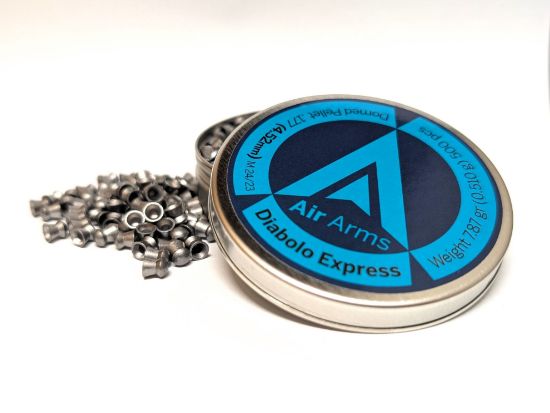
A .177 pellet measures approximately 4.5mm in diameter. A .22 pellet measures approximately 5.5mm. These differences underpin every comparison of .177 vs .22 air rifle calibre in terms of trajectory, energy, and application. A moderator designed specifically for .177 has a tighter bore, and that smaller clearance leaves less air escaping around the pellet, which is why a calibre-matched fit usually gives better performance. A moderator designed for .22 has a bore sized to accommodate the larger projectile - which means a .177 pellet will pass through it, and you can use a larger-calibre silencer on a smaller-calibre gun, but it is not usually the best-performing option. That is one practical difference buyers need to understand, especially as rifle power rises and bore clearance starts to matter more. Fit a .22 barrel to a .177 moderator and attempt to fire, and the pellet will collide with the baffle stack. That is a baffle strike.
Baffle strike risk is real
Using a moderator with a bore diameter smaller than your pellet calibre is not a performance issue - it is a safety issue. Using a smaller bore silencer on a larger calibre can cause pellet clipping or direct contact with the baffle stack. A baffle strike can damage the moderator, the barrel crown, and potentially result in injury. Always verify bore diameter before mounting any moderator.
Bore diameter is therefore the non-negotiable baseline of moderator compatibility. It must always be equal to or larger than the calibre of the rifle it is being fitted to. This is true regardless of thread pitch, brand, or price point, and a quality fit matters just as much as the thread itself.
Some moderators are marketed as multi-calibre - designed with a bore large enough to accommodate .22 and therefore technically passable for .177 as well. These can work, and non-calibre-specific silencers can be used across various calibers, but the fit is not always optimised for the smaller calibre, so calibre-specific silencers usually offer better performance and accuracy, particularly when you compare them with purpose-designed hunting moderators like the Q-Tec range.
Thread Pitch, Internal Volume, and Outer Diameter: The Other Half of Compatibility
Bore diameter determines whether a moderator is safe to fire through. Thread pitch determines whether it will physically mount on your rifle. These are two entirely separate considerations, and both must be correct. Many airgun moderators use a ½ inch UNF fitting, but you still need to confirm the exact thread on your own rifle.
Thread pitch is independent of calibre. Two rifles in .177 from different manufacturers can have completely different thread configurations. Equally, a .177 and a .22 variant of the same rifle model may share identical barrel threading - because the threading is determined by the rifle design, not the pellet diameter.
Thread pitch is rifle-specific, not calibre-specific
Do not assume that because two rifles share a calibre they share a thread pitch. Always check the thread specification for your exact rifle model and variant. To attach an air rifle silencer, you usually screw it onto the muzzle, so the thread has to match cleanly and squarely. Using an adapter to force a mismatched thread is not recommended - it introduces potential misalignment that affects both safety and moderator performance. If the fit is not true, shots can go off-course as well as reducing suppression.
The third dimension to check is outer diameter. Some rifles have a shrouded barrel, a silenced barrel housing, or a forend geometry that places a physical constraint on the maximum outer diameter of any moderator that can be fitted. Silencers can be fitted to both shrouded and non-shrouded barrels, provided thread, clearance, and alignment are all correct. A moderator with a large outer tube that threads on correctly but is too wide in its outer diameter may not clear the stock or shroud.
Before purchasing, you need to know three things about your rifle:
- The calibre - to establish the minimum safe bore diameter for the moderator
- The thread pitch and thread direction at the muzzle - to confirm a secure, aligned fit
- The available clearance around the muzzle - to confirm the moderator's outer diameter will not conflict with the stock or barrel housing
Can You Use a .22 Moderator Safely on a .177 Air Rifle?
This is the most common practical question, and the answer is conditional. A .22 moderator has a wider bore - large enough to allow a .177 pellet to pass through without striking the baffles. From a pellet clearance standpoint, the combination is not inherently dangerous in the same way as the reverse.
However, safe pellet passage is not the same as a compatible fitment. Several other factors must still align:
- Thread pitch must match the muzzle threading on the .177 rifle - a .22 moderator designed for a different thread standard will not fit correctly regardless of bore size
- Baffle alignment matters - some moderator designs have bore geometry that centres the pellet based on calibre-specific tolerances. A .177 pellet passing through a .22 bore has more lateral movement, which can affect consistency
- Sound attenuation is typically reduced - a longer moderator will usually produce a better dB drop than a shorter one because the extra length gives the air more expansion volume, while a larger bore around a smaller pellet can still make a given moderator less quiet than a properly matched unit
As a rule of thumb, when expansion volume doubles, muzzle pressure drops by roughly half, which is why size can make a real difference to noise reduction.
Consider a shooter who owns both a .177 and a .22 rifle and wants to share a moderator between them. If the thread pitch happens to be identical across both rifles and the .22 moderator is the one being shared, the .177 pellets will clear the baffles safely. But sound reduction will likely be noticeably less effective than a properly matched unit — and the setup only works if thread compatibility happens to align, which is not guaranteed.
The practical rule
A .22 moderator on a .177 rifle is physically possible in some configurations, but it is not an optimised solution. For best performance and safe, confirmed compatibility, select a moderator matched to the calibre and thread specification of your specific rifle.
Airgun Moderators Selection for Air Arms Rifles Available in Multiple Calibres
Several Air Arms rifles are offered in both .177 and .22 - which is where moderator selection requires particular attention. Choosing between these calibres already involves balancing factors like trajectory, impact energy and intended quarry, as explored in detail in our guide to the best calibre for air rifle hunting, .177 or .22. The same rifle model in two different calibres is not the same platform for moderator purposes.
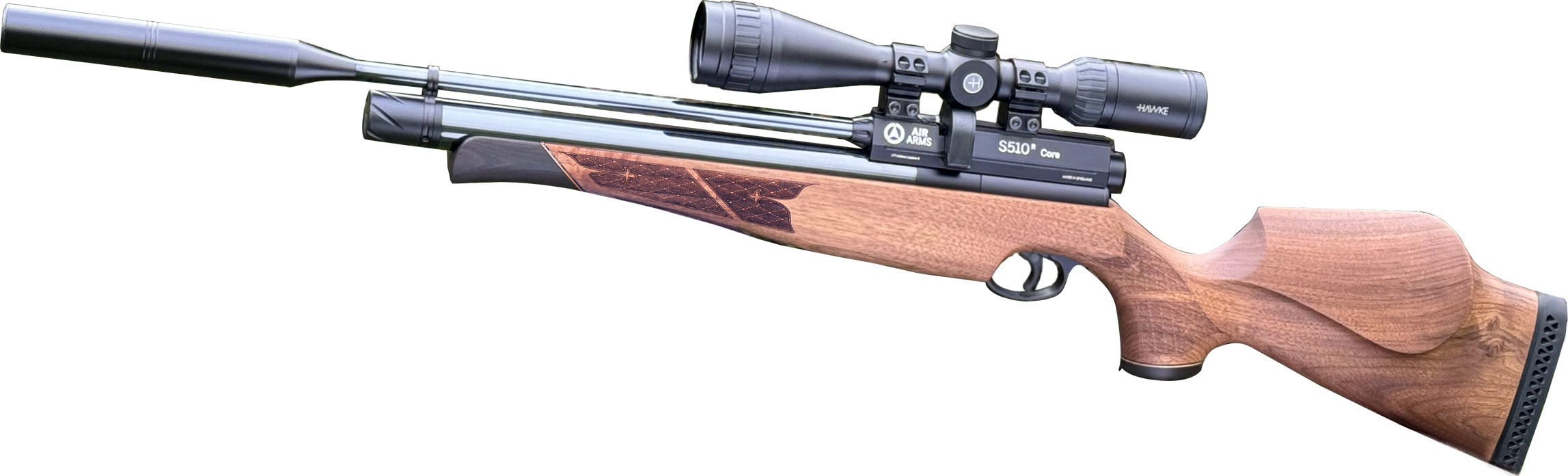
The S510 Tactical is a well-established example. A multiple Airgun of the Year award winner built on a regulated PCP platform, it embodies the advantages of PCP air rifle technology and combines modular design with advanced British engineering to suit a range of shooting applications. Available in both .177 and .22, the barrel specification — including bore diameter — differs between calibre variants. This approach is shared by other rifles in the S510 family such as the S510 Core with its integrated S-Tec Moderator. PCP air rifles generally benefit more from moderators than spring guns because there is less mechanical noise competing with the muzzle report. They are also usually quieter than spring-powered air guns to begin with, so moderator choice is often more noticeable in use. Any quality moderator selected for the S510 Tactical must be matched to the specific calibre version being fitted, not simply to the model name.
The Ultimate Sporter presents the same consideration. A precision-engineered PCP built in the UK with championship-proven performance across Field Target and competition disciplines, it is available in both calibres, reflecting the broader choice between .177 and .22 air rifle calibres that most shooters face. Shooters who upgrade or change calibre variant should treat the moderator selection process as a fresh decision rather than assuming existing accessories carry across. Moderator size, internal volume and length also need to suit the power level of the rifle, rather than being chosen on model name alone, just as power level and calibre selection become even more critical when you move up to UK-legal .25 calibre PCP hunting rifles.
Same model, different calibre - different moderator
Do not assume a moderator purchased for your .177 S510 Tactical or Ultimate Sporter will transfer directly to a .22 version of the same rifle. The bore diameter requirement changes with calibre. Verify both specifications before purchasing.
Thread pitch can also vary between calibre variants of the same model depending on barrel specification. Well-known examples such as the Donny FL Sumo are often cited for strong sound attenuation, but the fit still has to match the rifle and calibre. Some shooters using air guns also prefer a more light setup for balance, but fit comes first. With over 40 years of British engineering expertise behind every rifle Air Arms produces, the specs are precisely documented - which means the right information is always available. Contact your authorised Air Arms dealer or check the rifle documentation for the exact thread specification for your calibre variant.
How to Choose the Right Moderator for Your Specific Rifle and Calibre
The decision process for moderator selection is straightforward once you know what to check. Start with your rifle's documentation or the manufacturer - not the moderator specifications - because compatibility works outward from the rifle, not inward from the accessory. In air rifle use, silencers and moderators are essentially the same device, even if different shooters prefer different terms.
Moderator Selection: Step-by-Step
Confirm your calibre
Establish whether your rifle is chambered in .177 (4.5mm) or .22 (5.5mm). This sets the minimum bore diameter requirement for any moderator you consider. Never compromise on this - the bore must be equal to or larger than your pellet diameter.
Identify your muzzle thread
Check your rifle's specification sheet, manual, or speak to your authorised dealer to confirm the thread pitch and direction at the muzzle. Do not guess or assume based on calibre alone. Thread pitch is model and variant specific.
Check clearance and fitment
Measure or confirm the available space around the muzzle. If your rifle has a barrel shroud, integrated silencing, or a stock geometry that wraps close to the barrel end, the moderator's outer diameter must not exceed the available clearance.
Cross-reference the moderator specification
With your calibre, thread pitch, and clearance confirmed, evaluate moderators that meet all three criteria. Prioritise bore diameter first, thread compatibility second, and outer diameter third. A moderator that fails any of these is not the right choice regardless of its other qualities, in the same way that calibre choice for hunting should always start from ethical performance and suitability for your quarry, as outlined in our guide on which air rifle calibre is best for hunting.
Verify with your dealer
Before purchasing, confirm the combination with an authorised Air Arms dealer or the rifle manufacturer directly. This is especially important for newer rifles or where moderator specifications are not clearly labelled for your calibre variant. Air Arms' authorised dealer network can advise on confirmed compatible options for your specific rifle.
It is worth noting that some moderators list compatibility by calibre range - for example, a product labelled as suitable for .177 to .22. These multi-calibre units can be a practical solution where versatility is genuinely needed, but always cross-check that the bore diameter listed accommodates your specific calibre, and that the thread specification matches your rifle.
For Air Arms owners, the 3-year warranty on new rifles is worth keeping in mind when making any fitment decision. Ensuring accessories are correctly specified and properly mounted protects both the rifle and your warranty position. Shooting with a mismatched or improperly fitted moderator is not a category of use that any manufacturer's warranty is designed to cover.
When you get it right
A correctly matched moderator — right bore, right thread, right clearance — delivers consistent sound reduction without affecting accuracy or shot-to-shot consistency. It works by capturing and dispersing gas so the muzzle report is less sharp, much as suppressors do on firearms. The pellet passes centrally through the baffle stack, the system is aligned, and the rifle performs exactly as it should. That can make the shot more directional in the way it is heard, and reduce noise that might otherwise disturb neighbours. In practical terms, that matters for hunting and general field use, where reducing obvious muzzle noise can help conceal your position, but no moderator creates true silence and some air rifles can still sound surprisingly loud in the real-world sense.