



How to Get Started in Air Rifle Shooting in the UK
Air rifle shooting is one of the most accessible shooting sports in the UK. It requires no licence in England and Wales for rifles under the legal power limit, no membership of a governing body before you pick up a rifle for the first time, and no significant financial outlay to get started. Whether your interest lies in paper target shooting at an indoor range, knocking down field targets outdoors, or learning the fundamentals of marksmanship as a foundation for other shooting sports, air rifle shooting offers a clear and welcoming entry point.
This guide covers everything a complete beginner needs to know — from the legal basics and the different ways to shoot, through to finding a club, choosing your first rifle, and understanding what to expect in your first sessions.
Why Air Rifle Shooting Is an Ideal Starting Point
Of all the shooting disciplines available in the UK, air rifle shooting sits at the most accessible end of the spectrum. Sub-12 ft/lb air rifles can be owned by anyone aged 18 or over in England and Wales without a licence, registration, or police involvement. The rifles themselves are quiet, produce negligible recoil compared to firearms, and can be used safely at short ranges — including in a garden with an appropriate backstop.
For younger people, the picture is equally positive. Those aged 14 to 17 can borrow and use a sub-12 air rifle unsupervised on private land with the occupier’s permission. Under-14s can shoot under close supervision from an adult aged 21 or over. This accessibility makes air rifle shooting one of very few shooting sports that entire families can participate in together, often from the first session.
The sport also offers genuine progression. The same fundamental skills developed shooting paper targets at 10 metres — trigger control, breath management, consistent hold — transfer directly to outdoor disciplines and, for those who choose to go further, to centrefire and rimfire shooting. Many experienced rifle shooters trace the foundations of their accuracy back to time spent with an air rifle.
The Different Ways to Shoot
Air rifle shooting in the UK is not a single activity — it encompasses several distinct disciplines, each with its own format, equipment, and appeal. Understanding the options before you start will help you choose the right entry point.
Indoor target shooting is the most common starting point for beginners. Shooting takes place at a fixed distance, typically 10 metres, from a standing position. The environment is controlled, the distances are short, and the focus is entirely on technique and consistency. Many clubs have indoor ranges and can provide equipment for newcomers to try. This is also the Olympic discipline, which gives it a clear competitive structure for those who want to progress into national competitions.
Benchrest shooting involves firing from a supported, rested position to remove as many positional variables as possible. The emphasis falls on the accuracy of the rifle and ammunition rather than the shooter’s positional technique. It is a popular format at club level and a useful discipline for learning what your rifle is truly capable of without the complication of a free-standing hold.
Field target (FT) takes place outdoors, with metal knock-down targets set at unknown distances across a course. Targets have a kill zone — a circular aperture — that the shooter must strike to knock the target down. Distances vary and are not disclosed in advance, requiring the shooter to estimate range using parallax adjustment on the scope. It is a technically demanding discipline that rewards both accuracy and range-reading skill.
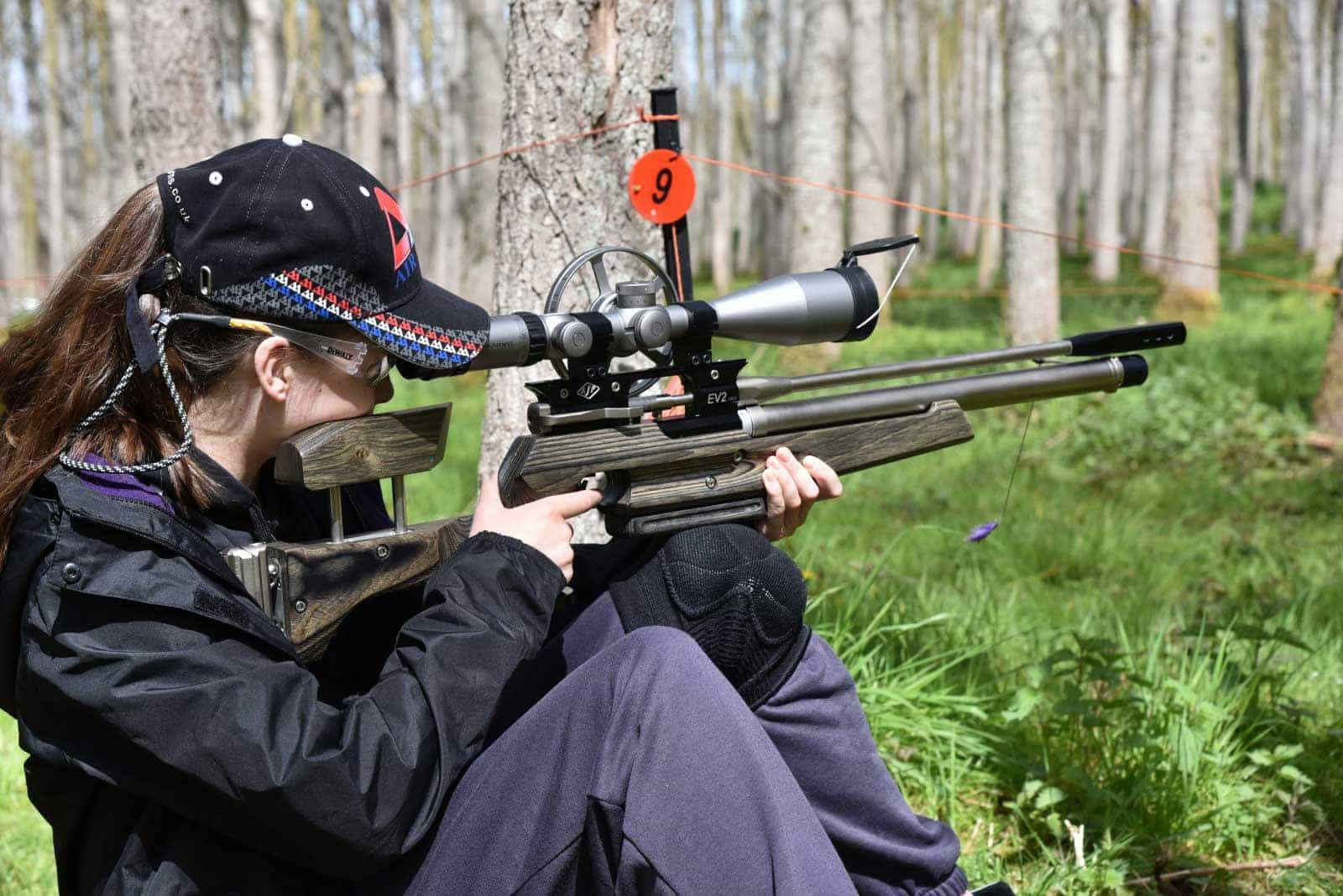
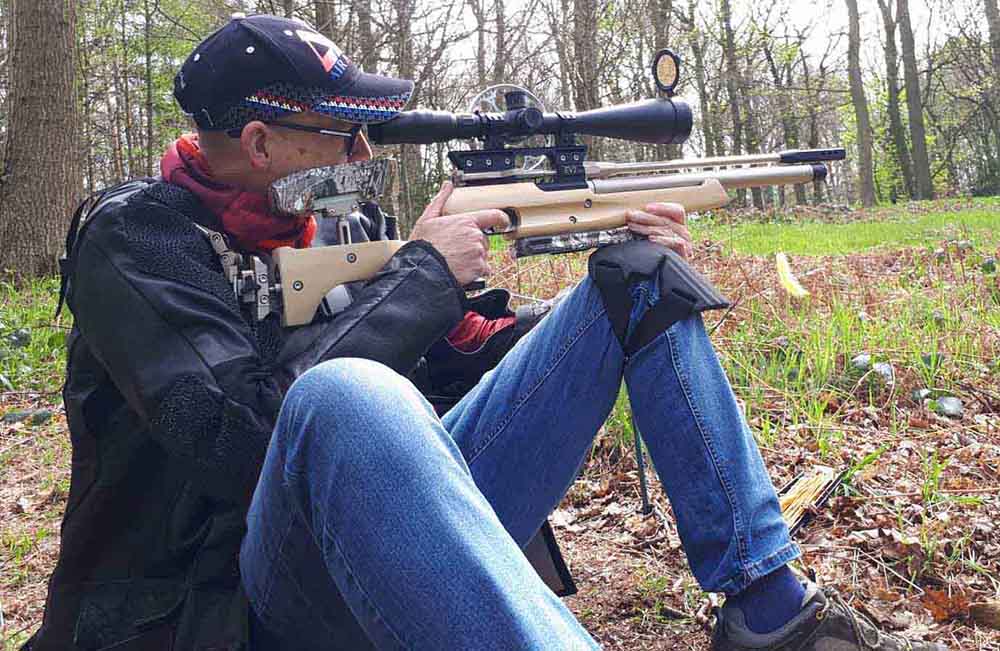
Hunter field target (HFT) follows a similar format to FT but is shot predominantly from the prone position, with rules that restrict scope adjustment. Targets are set between 8 and 45 yards and the discipline is designed to replicate the conditions of hunting in a controlled competitive environment. The UKAHFT (UK Association for Hunter Field Target) governs the discipline nationally and organises competitions throughout the year.
Plinking — informal shooting at reactive targets such as tin cans, spinner targets, or resetting knock-downs — sits outside the competitive structure but is enormously popular as a way to enjoy shooting in a relaxed setting. It is a great introduction to the sport for new shooters and an enjoyable way to maintain skills between more focused sessions.
Shooting at a Club vs Shooting at Home
New shooters in the UK have two realistic options for where to start: joining a club or setting up to shoot at home or on private land. Both are legitimate, and many shooters do both, but they offer different experiences.
A club provides access to a proper range, experienced instructors, structured sessions, and — in most cases — the ability to try equipment before buying. The social environment means that questions get answered quickly, mistakes are corrected early, and the experience of more established shooters is available simply by showing up and asking. Most clubs affiliated with the NSRA or the BFTA are open to complete beginners, and many hold introductory sessions or open days specifically for people who want to try the sport before committing to membership.
Shooting at home on private land — a garden, a farm, or any private property where you have permission — is entirely lawful for sub-12 air rifles, provided a few straightforward rules are followed. Pellets must not travel beyond the boundary of the property. A robust backstop capable of stopping pellets safely must be in place behind the target at all times. The rifle must not be visible from a public place. Within those conditions, a home range can be as simple as a pellet trap against a garden fence and a paper target at 20 yards.
For complete beginners, starting at a club is strongly recommended before shooting independently. The handling habits, safety awareness, and foundational technique that an experienced environment instils are genuinely difficult to develop in isolation and can take much longer to acquire without guidance.
Finding a Club
There are hundreds of airgun clubs across the UK catering to every discipline and experience level. Finding one close to you is straightforward using the resources available from the governing bodies.
The National Small-bore Rifle Association (NSRA) is the primary governing body for target shooting with air rifles and small-bore rifles in the UK. Their website hosts a searchable club finder covering over 800 affiliated clubs across England, Wales, Scotland, and Northern Ireland, spanning indoor target shooting, benchrest, and field disciplines. The NSRA also runs the British Open Air Gun Championships and a range of postal leagues that allow shooters to compete without travelling.
The British Field Target Association (BFTA) oversees field target shooting across England and Wales, organising regional leagues and national competitions. Their affiliated clubs run regular practice days and competitive events. The UKAHFT fulfils the equivalent role for hunter field target.
BASC (the British Association for Shooting and Conservation) also maintains a club finder on its website covering airgun clubs nationwide. For shooters interested in pest control as well as target shooting, BASC provides guidance on general licences, permissions, and safe shooting practice.
When contacting a club for the first time, it is worth asking:
Whether they run sessions or open days for complete beginners
Whether club equipment is available to use before buying your own
What disciplines the club focuses on
What membership fees cover and how sessions are structured
Whether the club has experienced instructors or coaches available
Your First Session: What to Expect
Most clubs welcome new members warmly and are well-practised at introducing complete beginners to the sport. A first session at a club will typically begin with a safety briefing covering the fundamental rules of airgun handling: always treat the rifle as loaded, keep the muzzle pointed in a safe direction at all times, keep the finger off the trigger until ready to shoot, and know what is beyond the target.
You will almost certainly be paired with an experienced club member or instructor who will guide you through the first few shots, correct your hold and position, and help you understand the basic operation of the rifle. Do not be concerned about performance in the first session. No one expects a beginner to shoot tight groups immediately, and experienced shooters universally understand that the early stages are about handling confidence and safety awareness rather than accuracy.
Many clubs have rifles available for visitors and new members to use, which removes the pressure of buying equipment before you know what you enjoy. Take advantage of this if it is available. Shooting different rifles and formats before committing to a purchase will give you a much clearer idea of what suits you.
Choosing Your First Air Rifle
Once you have decided to invest in your own rifle, the range of options available can feel overwhelming. For a beginner in the UK, the choice largely comes down to three variables: action type, calibre, and budget.
Spring-piston air rifles are the simplest and most affordable entry point. They are self-contained — no external air source or gas cylinder required — and require minimal maintenance. The trade-off is that they require more technique to shoot accurately than other types. A spring-piston rifle produces a two-stage recoil cycle: the piston travels forward and then bounces back, and the shooter must maintain a consistent, relaxed hold throughout this movement to avoid disturbing the shot. This demands slightly more discipline from the beginner but also builds good habits.
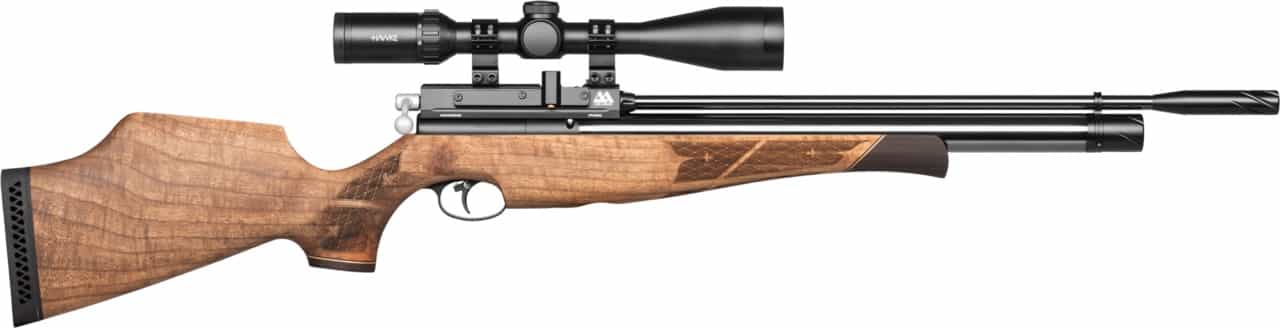
Pre-charged pneumatic (PCP) rifles use a reservoir of compressed air, either filled by a hand pump or a dive cylinder. They produce very little recoil, offer a high shot count per fill, and are generally easier to shoot accurately from the outset. They are more expensive than comparable spring-piston rifles and require access to a filling source, but for shooters who want to progress into competition or field shooting, a PCP is the platform most serious air rifle shooters use.
For calibre, .177 and .22 cover the vast majority of what is needed in sub-12 shooting. As a rule of thumb, .177 is favoured for target shooting due to its flatter trajectory and higher velocity, while .22 is popular for pest control and shorter-range field shooting where its greater energy transfer at impact is an advantage. Either is a perfectly sound choice for a beginner.
Budget at entry level does not need to be large. Quality spring-piston rifles from established manufacturers are available from around £150 to £300, and represent a capable, durable starting point. PCP rifles at beginner level start from around £300 upwards, with the additional cost of a filling solution on top. Visiting a club before buying allows you to handle and shoot different options, and most experienced club shooters will offer honest advice on what represents good value at any price point.
Essential Safety Rules
Safe handling is non-negotiable in air rifle shooting and should be treated as the first thing any new shooter learns, before anything else. The following rules apply at all times, in all settings:
Always treat the rifle as if it is loaded, even when you believe it is empty
Never point the rifle at anything you do not intend to shoot
Keep your finger off the trigger and outside the trigger guard until you are on target and ready to fire
Always be certain of what is beyond your target before shooting
Ensure a suitable backstop is in place before every shooting session
Never shoot in a public place without lawful reason
Store the rifle securely and out of reach of children when not in use
These rules are not formalities. They are the habits that keep shooting safe, and the shooters who internalise them early are the ones who go on to enjoy the sport without incident for decades. Every club, range, and responsible shooter operates by them.
The Shooting Community
One of the most consistently noted qualities of air rifle shooting in the UK is the quality of its community. Clubs are, without exception, genuinely welcoming to newcomers regardless of age, background, or prior experience. The sport attracts people from all walks of life and all age groups, and the shared focus on accuracy, patience, and improvement creates an environment where knowledge is readily shared and encouragement is the norm.
Competing in club events and open competitions is something beginners can and should consider doing early. You do not need to reach a particular standard before entering a competition — most events at club level are designed to be accessible to shooters at all stages of development, and the experience of shooting under competitive conditions is one of the most effective ways to accelerate improvement. You will almost always come away having learned something useful, regardless of where you finish.
Air rifle shooting rewards consistency, patience, and attention to detail more than physical strength or natural aptitude. It is a sport that genuinely improves with time and practice, and one where even experienced shooters continue to learn. Getting started is the most important step.