



Bolt Action Air Rifles UK
Bolt action air rifles have a clear, practical appeal - they are mechanically simple, satisfying to use, and well-suited to a wide range of shooting applications. For UK buyers, however, there are a few important questions to answer before making a purchase: what power limit applies, do you need a licence, and which calibre makes sense for how you plan to shoot? This guide walks through all of it in plain language, covering bolt action air rifles in the UK from legal basics through to practical buying advice.
What Is a Bolt Action Air Rifle and How Does It Work?
A bolt-action air rifle uses a manually operated bolt - a handle you pull back and push forward - to cock the rifle and, in some designs, load a pellet from a magazine. It is one of the most intuitive action types available, which is part of why it suits shooters who are new to air rifles or returning to the sport after a break.
The bolt action mechanism is different from other common air rifle types. A spring-powered break-barrel, for example, cocks the rifle by folding the barrel downward. An underlever like the Air Arms TX200 uses a lever beneath the barrel. A bolt action keeps the barrel fixed and uses the bolt stroke to do the work - which many shooters find produces a more consistent hold and a cleaner sight picture.
Bolt action rifles are produced across several power systems. Some use a pre-charged pneumatic (PCP) air system, where a reservoir is filled with high-pressure air. Others operate on a single-stroke or multi-stroke pump system. The action type (bolt) and the power source (spring, PCP, pump) are separate features - a point worth understanding when comparing models.
What 'bolt action' actually means
The bolt action refers to how the rifle is cocked and loaded - not to how it generates power. A bolt action air rifle can be spring-powered, PCP, or pump-driven. The bolt mechanism is simply the manual operating system that controls that cycle.
For shooters who value repeatability - especially when shooting from a rested position in the garden or at a club - the fixed-barrel bolt action design offers an advantage. There is no barrel movement to reintroduce between shots, which can support a more consistent shooting process.
UK Legal Power Limits: What the Sub-12 ft/lb Rule Means for Bolt Action Rifles
The most important rule in UK air rifle ownership is straightforward: in England, Scotland, and Wales, an air rifle may be owned and used without any licence or certificate - provided its muzzle energy does not exceed 12 ft/lb (foot-pounds). This limit applies regardless of the action type, so bolt action air rifles are subject to exactly the same rule as spring, PCP, or underlever designs.
This limit is set under the Firearms Act 1968, as amended, and applies across England, Scotland, and Wales. Northern Ireland operates under different legislation, so if you are based there, you will need to check the specific rules that apply. For the purposes of this guide, the focus is on the sub-12 ft/lb framework that governs the majority of UK shooters.
The sub-12 ft/lb rule in plain terms
If a bolt action air rifle produces 12 ft/lb of muzzle energy or less, no Firearms Certificate (FAC) is required to own or use it in England, Scotland, or Wales. If it exceeds 12 ft/lb, it is classified as an FAC-rated firearm and is subject to much stricter controls.
One thing worth understanding is that the 12 ft/lb limit is not a performance ceiling — it is a legal boundary. A well-engineered air rifle operating at or just below this limit can still deliver excellent accuracy and consistent shot-to-shot performance. Air Arms, manufacturing in the UK since 1983 and a multiple Airgun of the Year award winner (2019, 2020, 2021, 2023, 2025), engineers each rifle to perform reliably within the legal limit without sacrificing the accuracy or build quality that shooters expect.
Calibre affects where within the power envelope a rifle sits. A .177 rifle and a .22 rifle operating at the same muzzle energy will behave differently in terms of pellet velocity and trajectory - something covered in more detail in the calibre section below, alongside broader UK air rifle law and regulation.
FAC vs Non-FAC Bolt Action Air Rifles: Understanding the Firearms Licence Difference
The FAC (Firearms Certificate) distinction is the most important legal boundary in UK air rifle ownership. For many new shooters, it is also the most misunderstood, particularly when first learning whether air rifles are legal to own in the UK.
A non-FAC bolt-action air rifle operates at or below 12 ft/lb muzzle energy. You can purchase, own, and use one without any certificate, provided you meet the standard age requirements and are not otherwise prohibited from possessing firearms. For clarity on when you need a licence for an air rifle, this is the category that the vast majority of UK recreational shooters fall into.
An FAC-rated bolt-action air rifle exceeds 12 ft/lb. To own one, you must hold a valid Firearms Certificate, issued by your local police force. The application process for an air rifle licence involves background checks, a home visit, and documented reasoning for why you need the higher-powered rifle - typically linked to pest control on land where greater range or energy is required.
- Non-FAC (sub-12 ft/lb): No certificate required - suitable for most recreational and club shooting in the UK
- FAC (over 12 ft/lb): Firearms Certificate required - stricter conditions on storage, use, and transport
- The legal threshold is the same regardless of whether the rifle is bolt action, spring-powered, or PCP
- A rifle that was manufactured as sub-12 ft/lb cannot be used above that limit without entering FAC territory
For most people reading this guide, the non-FAC route is the appropriate one. If you are new to air rifles or shooting recreationally at home and at a local club, a sub-12 ft/lb bolt action air rifle gives you everything you need. The FAC route introduces meaningful legal responsibilities that go well beyond simply choosing a more powerful rifle.
Always verify power output before purchase
If you are buying a second-hand bolt-action air rifle, have the muzzle energy checked by a reputable dealer or club chronograph before use. A previously tuned or modified rifle may exceed 12 ft/lb even if it was originally sold as a sub-12 model. Ownership of an unlicensed over-limit rifle carries serious legal consequences.
.177 vs .22 Calibre: Which Is Right for UK Shooters?
Calibre choice is one of the first decisions any bolt action air rifle buyer faces, and it is worth getting right rather than defaulting to whichever is more readily available at the time. In the UK context, the two calibres that matter for most shooters are .177 and .22, and understanding the best calibre for air rifle hunting helps you match performance to your intended use.
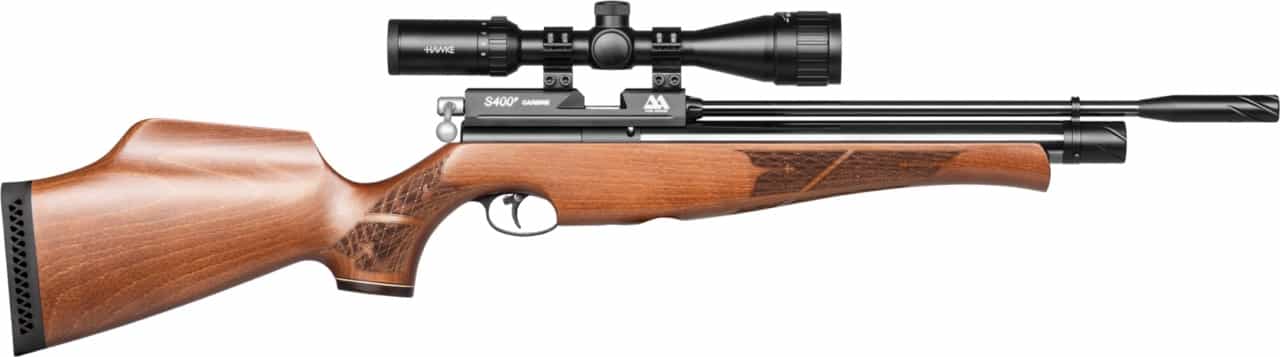
.177 Calibre: Flat Trajectory and Target Shooting Precision
A .177 bolt action air rifle fires a lighter pellet at higher velocity. The result is a flatter trajectory - the pellet drops less over distance - which makes it well-suited to target shooting and longer-range precision work. If you are shooting at a club, competing in any discipline, or spending time punching paper targets in the garden, .177 is typically the preferred calibre. Pellets for sub-12 ft/lb air rifles are cheaper than cartridges, which helps keep low running costs and regular target practice affordable.
The flatter trajectory also means that small errors in range estimation have less impact on where the pellet lands. For a beginner learning to shoot consistently, that margin for error is genuinely useful. The Air Arms S400 has been a popular budget air rifle since 2000, known for being cheap, well-made, and accurate. Many UK competitive disciplines - including HFT (Hunter Field Target) - are contested primarily with .177 rifles.
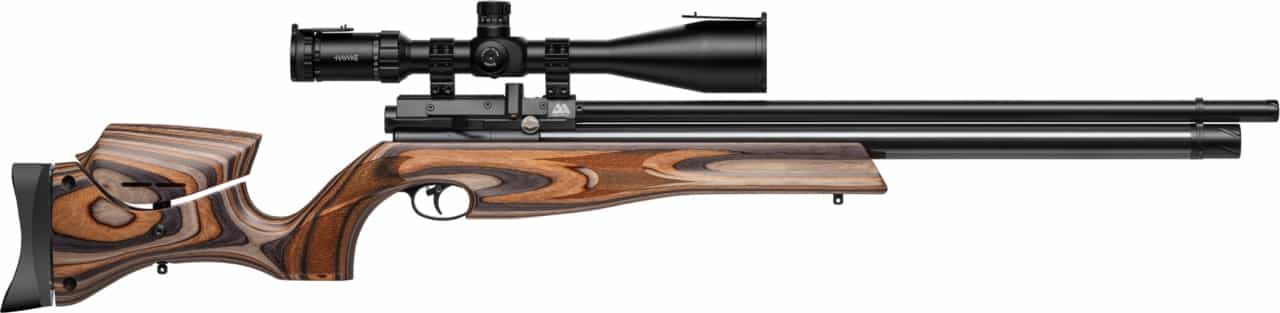
.22 Calibre: More Energy at Shorter Ranges
A .22 bolt action air rifle fires a heavier pellet. Within the same 12 ft/lb power envelope, the pellet travels more slowly but carries more energy at typical pest control distances. This makes .22 a popular choice for shooters who are using their rifle for humane pest management on land where they have permission. Always zero your rifle before starting any hunt.
The trade-off is trajectory. A .22 pellet drops more noticeably over distance, which means you need to be more precise about judging range - particularly beyond 25 to 30 yards. Responsible pest control also means not shooting at quarry less than two metres from their burrow. For close-range work where stopping power per shot matters more than long-range flatness, that trade-off is usually acceptable.
Choosing calibre by intended use
If your primary use is target shooting, club shooting, or garden plinking at longer distances, start with .177. If your main purpose is pest control at close to medium range, .22 is worth considering. When in doubt, speak to a dealer or your local club - most can let you try both before you commit.
Where Can You Legally Use a Bolt Action Air Rifle in the UK?
Owning a sub-12 ft/lb bolt-action air rifle without an FAC is one thing - knowing where you can legally use it is just as important. The rules around shooting location are practical and largely common sense, but they are worth understanding clearly. If you are shooting on private land, you still need to do it safely and make sure no pellets leave the boundary. Some airguns are extremely quiet when used with sound moderators, but lower noise does not remove the need for an effective safe setup.
Private Gardens and Land
Shooting in a private garden is legal, provided you have permission from the landowner (which, if it is your own garden, you already have) and you can shoot safely without the risk of pellets leaving the boundary. A suitable backstop - such as a purpose-built target trap - is essential. The question to ask is whether a pellet that misses the target could travel beyond your boundary and cause harm or damage. If the answer is yes, the location is not safe for shooting, and you should review detailed guidance on shooting an air rifle in your garden.
Air Rifle Clubs
Shooting at a club is one of the best ways to get started with a bolt action air rifle. Clubs provide supervised ranges with appropriate backstops, access to coaching, and the social element of shooting alongside other enthusiasts. Many clubs are affiliated to NSRA (National Small-bore Rifle Association) or BASC and operate to established range safety standards.
Pest Control on Land with Permission
If you are using a bolt action air rifle for pest control - targeting rabbits, rats, or grey squirrels, for example - you must have the explicit permission of the landowner to shoot on that land, ideally in writing to help avoid disputes or legal issues. It is also your responsibility to understand which species you can legally shoot and when. Some species are protected, and shooting them without authorisation carries serious penalties. Entering land with an air rifle without permission can amount to armed trespass, which is a serious offence. BASC publishes helpful guidance on legal quarry species in the UK.
- Private gardens - with permission, a safe backstop, and no risk of pellets leaving the boundary
- Air rifle clubs and indoor ranges - supervised, purpose-built, and legally safe
- Private land - with explicit landowner permission and awareness of quarry species legality
- Field target and HFT courses - run through clubs on dedicated land
Shooting on public land - parks, footpaths, or open countryside without landowner permission - is not permitted. The law on this is clear, and the risks to other people and to your own legal standing are significant. If you are not sure about a location, the safest approach is to contact your local club or BASC for guidance.
What to Look for When Choosing a Bolt Action Air Rifle in the UK
With the legal framework understood, the practical question becomes: what actually makes a good bolt action air rifle for a UK shooter? There is no single answer - it depends on intended use, experience level, and budget - but there are consistent factors that separate a well-considered purchase from one that causes frustration.
Key Factors to Evaluate Before Buying
Verified Power Output
For a non-FAC purchase, confirm that the rifle is manufactured and tested to operate below 12 ft/lb. Reputable UK manufacturers build and test their rifles to meet this standard — this is non-negotiable as a starting point.
Calibre for Intended Use
Decide on .177 or .22 based on how you plan to shoot — .177 for target work and longer-range precision, .22 for closer-range pest control. If the rifle will be used for pest control, a multi-shot magazine can also be valuable for quick follow-up shots. Switching calibre later usually means buying a different rifle, so choose carefully upfront.
Stock Fit and Trigger Quality
A rifle that fits you well will always outperform one that does not. Look for an adjustable stock where your budget allows, and evaluate the trigger carefully — a consistent, crisp trigger break builds good shooting habits, while an unpredictable trigger makes accurate shooting harder to learn.
Build Quality and After-Sales Support
Look for a rifle backed by a meaningful warranty and serviced through an authorised dealer network. Air Arms rifles are covered by a 3-year warranty and supported through dedicated aftersales service — giving buyers genuine long-term confidence in their purchase. Simple upkeep matters too, because air rifles should be stored dry and clean. Use a proper barrel cleaning kit for maintenance, and wipe metalwork with a lightly oiled rag after use. Only use lubricants recommended by the manufacturer.
The TX200, while an underlever rather than a bolt action, is often cited as a reference point for what UK-manufactured air rifle engineering looks like at its best — precise, reliable, and built to perform consistently within the legal power envelope without compromise. That standard of engineering is what to look for across any Air Arms platform.
For a new shooter, that consistency matters — it means you can trust the equipment and focus on developing your technique rather than troubleshooting the rifle.
Buying from a reputable source matters
A new bolt action air rifle purchased from an authorised UK dealer will have been set up and checked to the manufacturer's specification. Private sales can offer good value, but always have a second-hand rifle checked on a chronograph before using it - particularly if it has been modified since leaving the factory.
The best bolt action air rifle for a UK buyer is one that fits your intended use, shoots consistently within the legal limit, and is backed by proper after-sales support. Take time with the decision, handle options where you can, and use your local club or a trusted dealer as a resource — they will give practical, honest guidance. After all, it is you and Air Arms: a winning combination.